

North Facing House Vastu: Complete Guide to Entrance Direction, Room Placement, Benefits & Vastu Tips
Is a north-facing house good as per Vastu Shastra? Which direction should the main entrance face? Where should the kitchen, master bedroom, living room and pooja room be located?
North-facing houses have traditionally been popular among Indian homebuyers because the north direction is associated with Lord Kubera, the deity of wealth and prosperity in Hindu tradition.
In Vastu Shastra, the north direction is traditionally connected with financial growth, opportunities and positive associations. However, simply purchasing a north-facing property does not automatically make it Vastu-compliant. The exact entrance placement, internal room arrangement, plot shape, natural light, ventilation and overall architectural planning also play important roles.
Whether you are planning to purchase a new apartment, construct an independent house, invest in a residential plot or renovate your existing property, understanding north-facing house Vastu can help you evaluate your options more carefully.
In this comprehensive guide, ReConsult Advisory Services explores the traditional principles of north-facing house Vastu, including the best entrance positions, room directions, kitchen placement, bedroom locations, colours, common mistakes and practical remedies.
Let's understand how to plan a north-facing home that balances traditional preferences with modern living.
1. What Is a North-Facing House as per Vastu Shastra?
A north-facing house is generally understood as a property where the principal entrance is located on the northern side, allowing a person standing inside the home and facing the main entrance to look towards the north.
In traditional Vastu Shastra, north is associated with Lord Kubera, who symbolises wealth, abundance and prosperity. The direction is also traditionally associated with the water element in certain Vastu interpretations and is considered an important zone in residential planning. North-facing homes are often preferred by families who follow traditional Vastu principles and wish to incorporate directional considerations into their home design.
However, it is important to understand that a north-facing property and a Vastu-compliant property are not necessarily the same thing.
A complete Vastu assessment may consider:
- The exact location of the main entrance.
- The orientation and shape of the plot.
- The placement of bedrooms and living spaces.
- The location of the kitchen.
- The position of staircases and toilets.
- The distribution of open spaces.
- Natural light and ventilation.
- The surrounding buildings and external environment.
Expert insight: The direction of a house is only the starting point of a Vastu assessment. The complete floor plan provides a much better understanding of how the property aligns with traditional Vastu principles.
2. Is a North-Facing House Good as per Vastu?
Yes, north-facing houses are traditionally considered favourable in many schools of Vastu Shastra.
The north direction is associated with Lord Kubera, representing wealth, financial stability and prosperity. This cultural association makes north-facing properties a popular consideration among Indian homebuyers.
Some traditional Vastu principles recommend maintaining openness and avoiding unnecessary obstructions in the northern zone.
Traditional benefits associated with north-facing homes
1. Association with prosperity : North is traditionally linked with Kubera and is considered a direction associated with wealth and financial opportunities.
2. A welcoming entrance : A properly planned northern entrance can create an attractive and functional approach to the home.
3. Natural lighting opportunities : Depending on the property's geographical location, surrounding buildings and window placement, a north-facing facade can receive relatively consistent, indirect daylight.
4. Flexible architectural planning : A north-facing plot can accommodate different architectural layouts, subject to its dimensions, setbacks, building regulations and family requirements.
5. Popularity among Vastu-conscious buyers : North-facing properties often attract buyers who prefer traditional directional considerations while selecting residential real estate.
Does a north-facing house guarantee wealth and success?
No. Vastu Shastra is a traditional architectural belief system. There is no scientific evidence that the direction of a residential entrance guarantees financial success, health, career growth or prosperity.
The traditional associations can be respected as cultural preferences, but actual financial well-being depends on many factors, including income, financial decisions, employment and investment choices.
3. Best Main Entrance Placement for a North-Facing House
The main entrance is one of the most important considerations in traditional Vastu planning.
Many homeowners assume that any entrance on the northern side is automatically ideal. This is not entirely accurate.
Traditional Vastu systems divide the building's perimeter into smaller directional sections, often called padas. Different sections may have different traditional interpretations.
Understanding the northern entrance zone
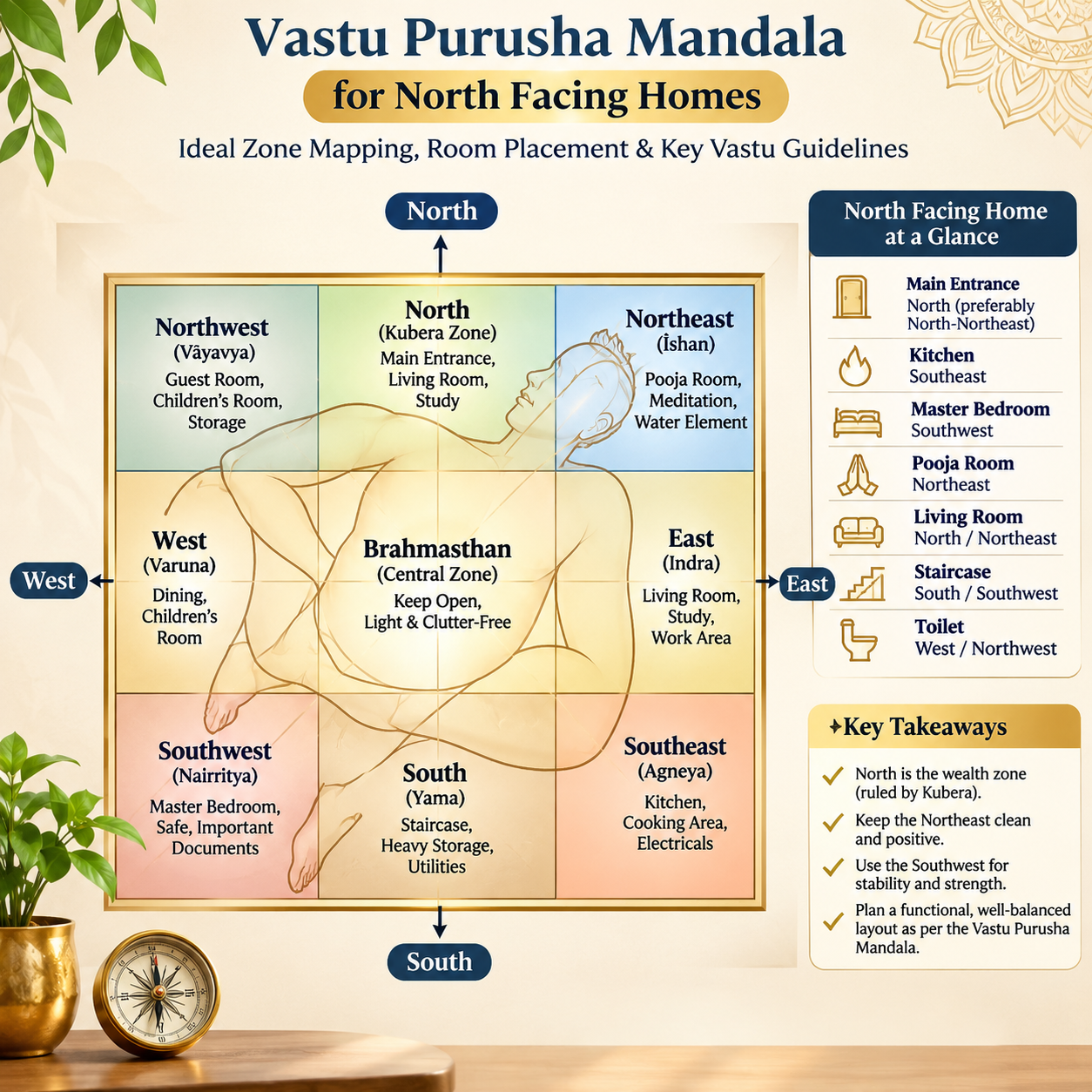
The northern side is traditionally associated with Kubera. Within the north-facing perimeter, entrance placement is assessed using the relevant directional divisions of the Vastu Purusha Mandala.
A detailed assessment may consider:
- The overall width of the northern boundary.
- The exact location of the main door.
- The directional subdivisions used in the selected Vastu system.
- The relationship between the entrance and the internal floor plan.
- The surrounding physical environment.
Some traditional Vastu interpretations identify specific northern entrance padas as favourable, but the names, measurements and interpretations should be verified against the particular Vastu tradition being followed.
How to evaluate the main entrance
- Identify the actual geographical north using a reliable compass.
- Confirm the orientation of the plot and building.
- Identify the northern boundary.
- Locate the centre and relevant directional divisions of that boundary.
- Mark the main entrance position on the architectural plan.
- Evaluate the entrance alongside the complete floor plan.
Important: Do not select a property simply because its entrance is labelled north-facing. Two north-facing homes can have very different layouts and traditional Vastu assessments.
4. Ideal Room Placement in a North-Facing House as per Vastu
Room placement is another major consideration when planning a north-facing residential property.
Traditional Vastu principles associate different directions with different activities and elements.
The following table provides commonly recommended room placements. These are general traditional guidelines, not universal architectural requirements.
| Room or area | Commonly recommended direction |
|---|---|
| Main entrance | North, subject to precise placement |
| Living room | North, northeast or northwest |
| Pooja room | Northeast |
| Kitchen | Southeast; northwest is an alternative in some traditions |
| Master bedroom | Southwest |
| Children's bedroom | West, northwest or suitable alternative |
| Guest bedroom | Northwest |
| Study room | East, north or northeast |
| Staircase | South, west or southwest |
| Toilets | West, northwest or other suitable zones, depending on layout |